
Rivage Puzzle Types
Physical machines and station paperwork, not abstract puzzle boxes floating in a void.
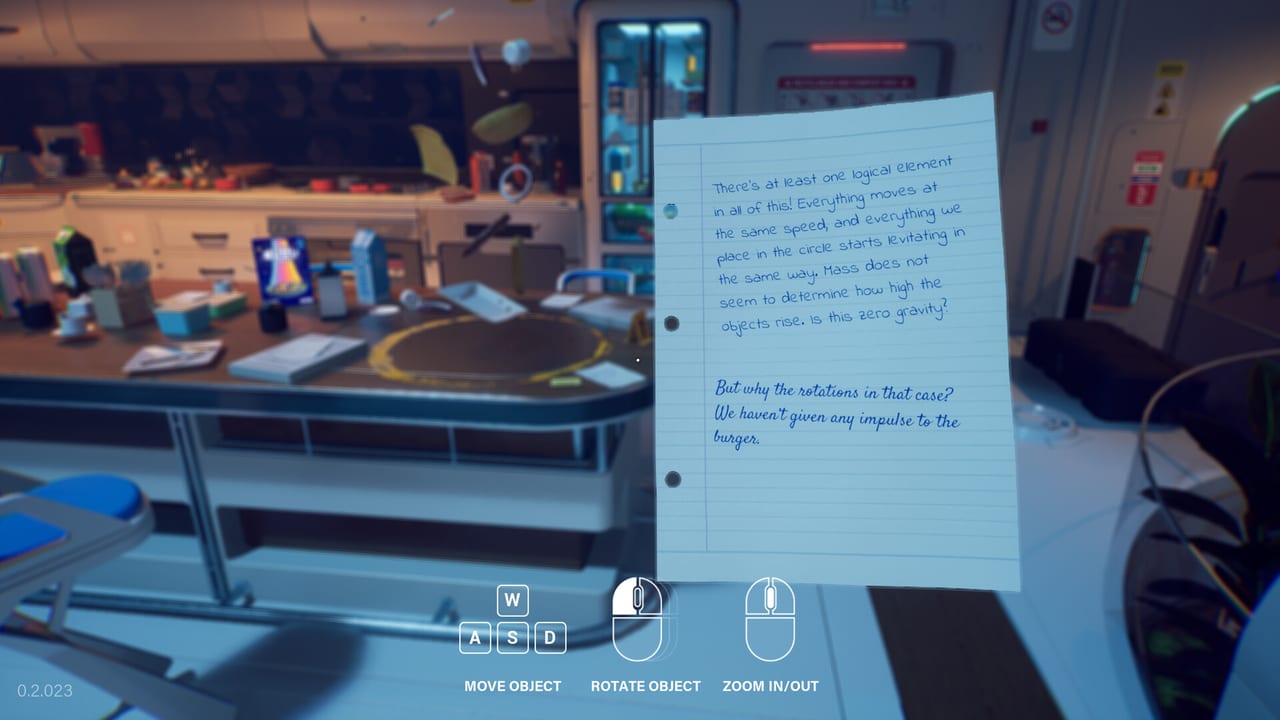
Every Rivage puzzle is a broken piece of station A.R.E.S. You are not walking into a themed quiz room. You are repairing, realigning, or decoding something Miranda Vigneau would have touched on a normal research day: a safe, a pharmacy, a cube in the astro lab, a keycard reader, a color board. Gravity, magnetism, and time are the physics verbs. Emails, audio logs, and lockers are the story verbs. The two share the same corridors.
This catalog is written from the dedicated demo path plus official descriptions of the full game. It is not a spoiler map of every September 22 room. When a machine appears in the first hour, the walkthrough has the route. This page tells you what family you are looking at so you stop spending station power on the wrong kind of experiment.
Physics: gravity, magnetism, time
Exnilo and Raw Fury pitch three environmental axes. Gravity puzzles change how objects rest or how a room orients. Magnetism fits the anomaly story: VESTA research, warped fields, things that should not stick or should not move. Time puzzles are not a pause menu; they are machines and rooms that disagree with the last loop. The kitchen anomaly in the demo is the teaching moment: you return and the space is not honest.
Handle these like lab equipment. Screenshot the starting state. Change one variable. If the station starts blinking low power, stop. A physics toy that needs three tests is cheaper across two loops than as a panic mash in one.
Paper and passwords: emails, safes, audio logs
The opening cabin is a paperwork dungeon. Emails hide the birthday recovery (type K, then 000, then the birthday you find in quarters). The safe opens on Stardust, Miranda’s book. Audio logs show up later as reconstructed sound (the lobby jigsaw) and as disks in lockers. None of these are optional flavor if they print a code. Bank them in K9 the second they work.
Read like a researcher. Names on messages match doors: Dahia, Johnny, Aman, Rafi. A passive-aggressive battery note from Johnny is a route. A sleepless log from Aman is both story and a reason his locker exists. If a log mentions a box in the kitchen, that box is a machine, not set dressing.
Power toys: batteries, pharmacy, pod bay
The emergency pharmacy is the demo’s logistics puzzle. Three cells spawn across floors. You hold one at a time. The cells must sit next to the machine. Typical first-hour placements: beside the pharmacy, in robotics/workshop, in cultivation. The pharmacy can keep running on those cells after the main grid dies, which is how you still select bay pod access in a blackout.
Treat batteries as a family you will see again, not a one-off. Any device that wants local power is telling you it can outlive a loop’s last seconds. Any device that only talks to the station bus cannot. Do not carry a cell into the pod bay “just in case” unless a note says that bay has its own slots.
The pod bay itself is a destination unlocked by a service menu, not a maze. Look, screenshot, leave. Spending a full bar sightseeing after you already bought access is how color panels get skipped.
Access toys: keycards, lockers, broken badges
Readers on A.R.E.S. have levels. A level-one card does not open a level-two door. The lobby teases a level-four reader you should photograph and ignore on loop one. The broken keycard set-piece asks you to rebuild an identifier and barcode from damaged pieces. The interface clicks as you drag; slow down. A finished card can still fail on a physically smashed cabin door. Use it on living readers.
Lockers are puzzles that look like storage. Glyphs repeat between a cabin locker and a later symbol. Aman’s locker is a late-demo payoff that wants the access you earned, not a random smash. Miranda’s locker hides the key to his kitchen box, which is a character beat: her space is holding his things. Screenshot locker interiors before you take the arcade reset; the photo is cheaper than a second visit.
Physical boards: cubes, color panels, jigsaw audio
The astro lab cube is a tactile, Rubik-like object in a real room. You stand there and turn it. The lobby color panel is a sequence board with its own prerequisite computer and a contactless K9 update; the dedicated color puzzle guide is the hatch walkthrough. The jigsaw audio puzzle is assembly with your ears. Official trailers also show rotating maps and wall hardware that belong in this family for the full game: things you grab, not things you highlight in a list.
Rules that hold across boards:
- Photograph the unsolved state.
- Photograph any matching glyph elsewhere on the station.
- Change one face or one color at a time.
- If K9 offers to store a solution, let it. Re-solving a cube after Time Trickster is how people quit.
How puzzles talk to the loop
A puzzle has three costs: the power to reach it, the power to run it, and the attention to document it. The first two are station battery. The third is K9. If you solve a board and do not bank it, you paid twice. If you document a board and do not solve it, you still paid once for a smarter next loop, which is acceptable.
Some solutions are not meant to complete on the loop you found them. A code might open a door you cannot afford to walk through until you have pharmacy access. That is not unfinished design. That is the loop planner use case: park the code, spend the next morning on the door.
What this page will not do
It will not list every shipping-game combination of gravity and magnetism. Those rooms are still behind the September 22, 2026 launch. It will not pretend the demo’s color panel is the last puzzle in Rivage. It will not dump numbers that belong on a whiteboard in your own screenshot, because those numbers are how the station makes you look.
Use the guides hub when you need a different angle: getting started for the packing list, controls if interact and rotate feel sticky, Miranda if you forgot whose book Stardust is. Then go back to the machine in front of you and change one variable.
Frequently Asked Questions
Quick answers to the most common questions.
What kinds of puzzles does Rivage use?
Gravity, magnetism, and time, plus physical machines: emails, safes, batteries, keycards, audio logs, cubes, color panels, pharmacy cells, pod-bay menus, and lockers.
Are demo puzzles the full game?
No. The demo path is a first-hour classroom. The September 22 campaign repeats these families in more of A.R.E.S., not only the lobby and pharmacy.
How do I keep a solution after a reset?
Bank it in the K9 system. Screenshots and stored steps persist. The physical cube or card in the world resets with the loop.
Why can't I carry all three pharmacy batteries?
The demo path lets you hold one item at a time. Seat each cell next to the emergency pharmacy before you fetch the next. See the walkthrough for the route.
A keycard reader will not accept my card. Is it broken?
Check the level on the reader. A rebuilt level-two card still fails on a smashed door or a level-four lobby lock. Photograph the reader and spend power elsewhere.